KEMO: Event-Driven Keyframe Memory forLong-Horizon Robot Manipulation with VLA Policies
1Hong Kong Embodied AI Lab 2The Chinese University of Hong Kong 3xdof.ai 4University of Electronic Science and Technology of China 5Shanghai Jiao Tong University
Abstract
Long-horizon robot manipulation remains challenging because similar observations may occur at different execution stages, while the appropriate action depends on previously completed operations. Memory can address this ambiguity by enabling policies to infer task progress from execution history. However, existing memory-augmented approaches often retain dense histories that require compression or rely primarily on recent context that may discard earlier task-relevant events. In this work, we propose KEMO, a lightweight plug-in memory framework that automatically and selectively preserves keyframes associated with task-relevant state changes for VLA policies. KEMO combines robot kinematics with visual filtering to detect events, encodes the selected keyframes as compact temporally ordered memory tokens, and integrates them with current visual features through cross-attention and gated residual fusion for VLA training. The detected events also define higher-weight training samples near critical transitions. We evaluate KEMO on various real-world dual-arm manipulation tasks spanning 2 to 6 scored subtasks, and trajectory length ranging from 830 steps to 2846 execution steps (durations from 28 to 95 seconds). Compared with the memory-free baseline (e.g., π0.5), KEMO improves aggregate Task Success Rate by 23.6% and Stage Completion Rate by 34.1%. Ablations show that event-driven keyframe selection outperforms uniform sampling and recent-frame retention, while the proposed gated fusion and keyframe-aligned loss weighting provide complementary gains.
Method
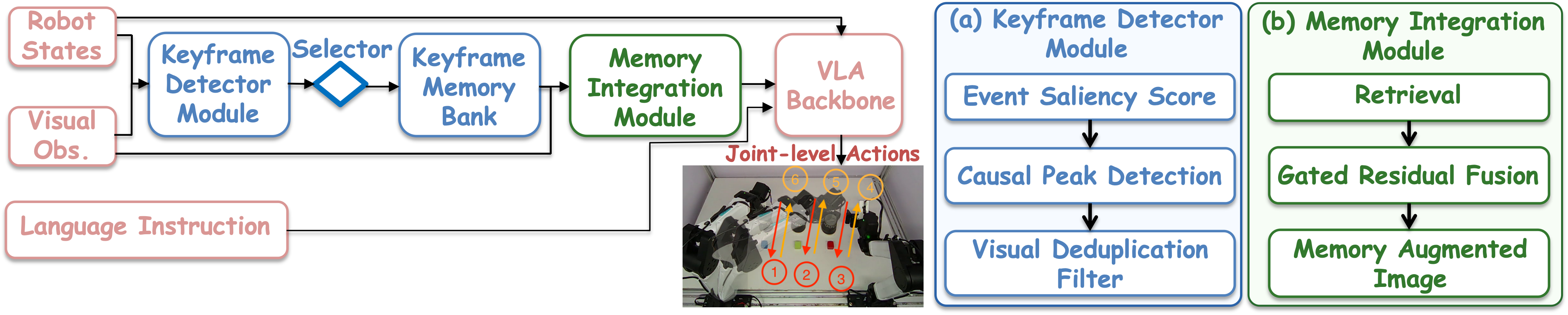
Event-driven keyframe memory framework. Keyframe detector module use robot states and visual observations to select task-relevant event keyframes, which are stored in a keyframe memory bank. The memory integration module retrieves the stored keyframes and fuses them with the current visual representation, enabling the VLA backbone to predict actions using both current observations and historical transition evidence. Right: module details for keyframe detection and memory interaction.
Keyframe Detection
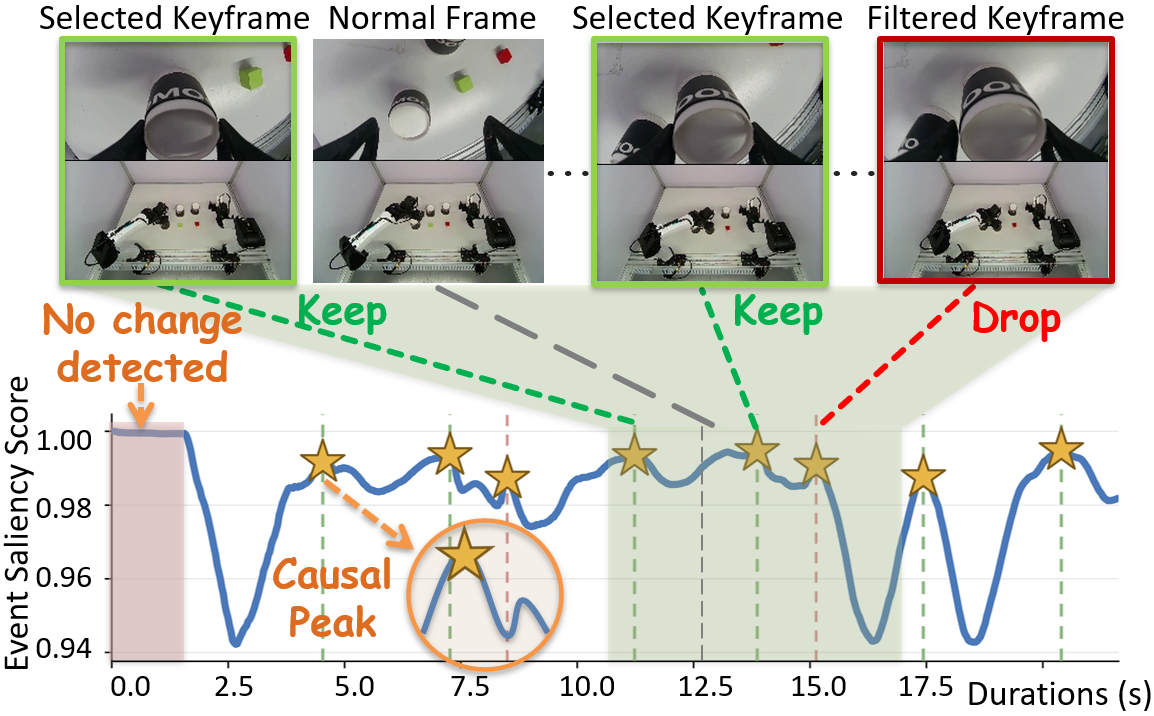
Event-driven keyframe detection. The keyframe detector computes an event saliency score from robot motion, identifies candidate keyframes through causal peak detection, and applies a visual deduplication filter to keep only candidates associated with meaningful scene changes. Selected keyframes are stored, while visually redundant or non-transition frames are filtered out.
Memory Integration
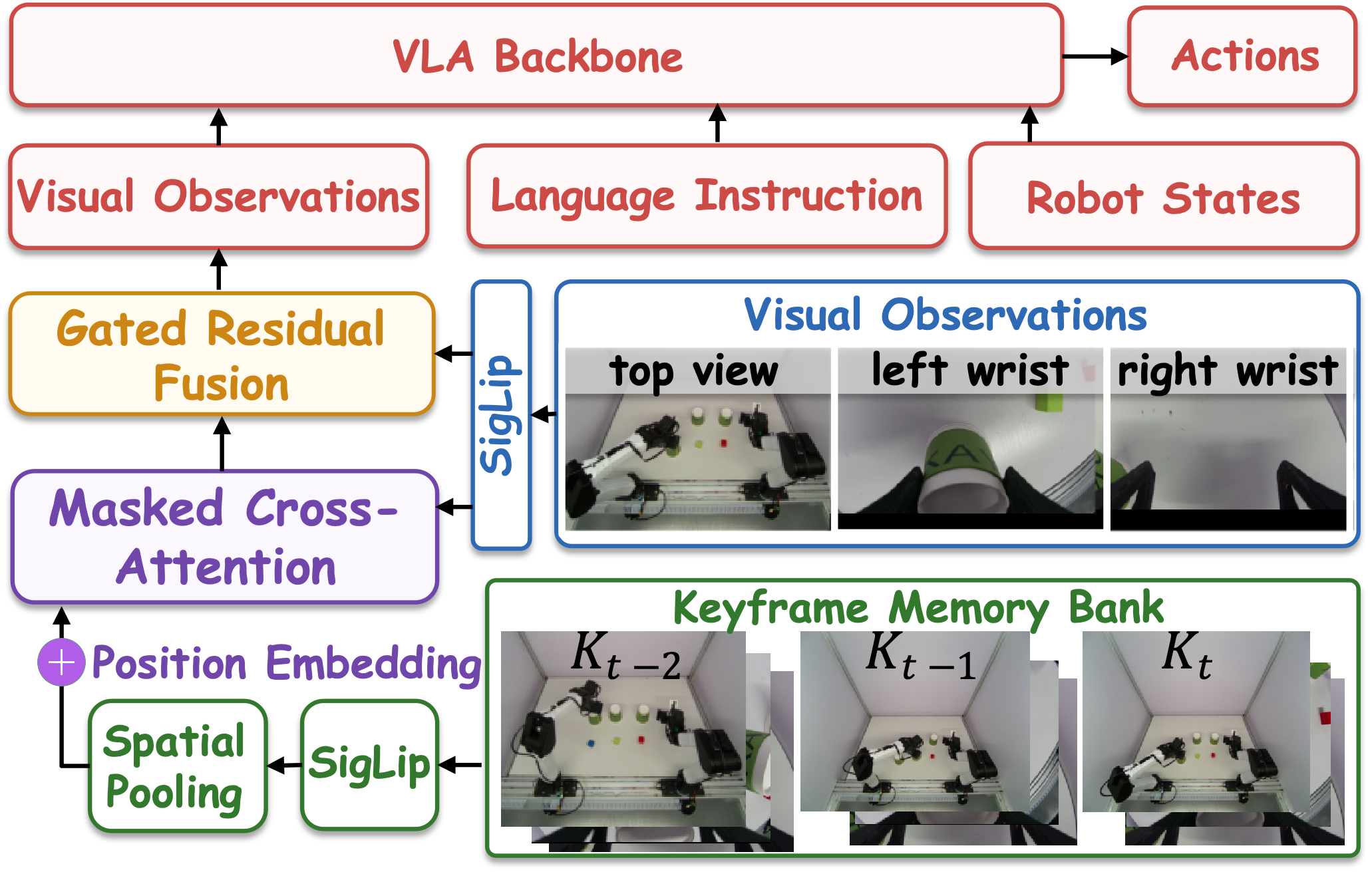
Memory integration. The memory integration module encodes stored keyframes with the visual encoder, applies spatial pooling and temporal positional embeddings, retrieves keyframe memory tokens, and fuses them with the current visual representation through masked cross-attention and gated residual fusion before action prediction by the VLA backbone.
Real-World Experiments
Six real dual-arm memory-dependent manipulation tasks.
Find Block
Cover Blocks
Box Refill
Make Sandwich
Drawer Items Replacement
Results
TSR is full-task success. SCR is the average number of correctly completed stages in sequence.
+23.6%aggregate Task Success Rate (TSR) gain over π0.5
+34.1%aggregate Stage Completion Rate (SCR) gain over π0.5
6 tasks2–6 scored subtasks, 28–95 s per trajectory
| Method | Swap Foods | Find Block | Cover Blocks | Box Refill | Make Sandwich | Drawer Items Replacement | ||||||
|---|---|---|---|---|---|---|---|---|---|---|---|---|
| TSR | SCR | TSR | SCR | TSR | SCR | TSR | SCR | TSR | SCR | TSR | SCR | |
| π0.5 | 6/12 | 1.500/2 | 0/12 | 0.353/4 | 0/12 | 1.333/6 | 4/12 | 2.580/4 | 10/12 | 3.330/4 | 0/12 | 0.000/4 |
| MemoryVLA | 1/12 | 0.750/2 | 0/12 | 1.000/4 | 0/12 | 0.333/6 | 0/12 | 0.000/4 | 0/12 | 1.000/4 | 0/12 | 0.000/4 |
| Ours | 8/12 | 1.580/2 | 2/12 | 3.167/4 | 9/12 | 5.250/6 | 7/12 | 3.330/4 | 11/12 | 3.750/4 | 0/12 | 1.417/4 |
Citation
BibTeX
@misc{zeng2026kemoeventdrivenkeyframememory,
      title={KEMO: Event-Driven Keyframe Memory for Long-Horizon Robot Manipulation with VLA Policies},
      author={Yihan Zeng and Minghao Ye and Yiyuan Chen and Yide Shentu and Philipp Wu and Zike Yan and Zhongyu Li},
      year={2026},
      eprint={2606.23589},
      archivePrefix={arXiv},
      primaryClass={cs.RO},
      url={https://arxiv.org/abs/2606.23589},
}